Showing posts with label chokecherries. Show all posts

Wednesday, March 13, 2013

Chokecherry Success?

A friend of mine mentioned to me a while back that she had a cone-shaped strainer and pestle.  She has graciously allowed me to borrow it to try my hand at it with my chokecherries.  She also harvested a bunch of chokecherries this summer/fall but she didn't try the strainer with hers as she was just making jelly.  I, on the other hand, would like to make fruit leather, which takes pulp not just the juice.


Yet again optimistic, I threw a spoonful of chokecherries into the cone and went to work.  The result?


Pulp into the bowl and whole pits and skins left in the cone!  I wouldn't mind putting the skins in, too, if I can figure out how to best do that, but for now I call this a success.  

Friday, March 8, 2013

The Chokecherry Saga Continues

Last week, after quite a bit of research on a good, mechanical way to remove the pits from the pulp, skin, and juice of chokecherries, we thawed out a few bags of chokecherries to attempt to make some chokecherry leather, which we've heard is very good and highly nutritious.  I was optimistic as I read that several people simply remove the spring from their Victorio food strainer and it works the chokecherries through just fine.  Well, we don't have a Victorio but I thought maybe it would still work to just remove the spring from our Kitchen Aid Fruit and Vegetable Strainer for my stand mixer.

I put a spoon of chokecherries in the hopper and turned it onto the slowest setting.  It was going okay but didn't even get any of the juice/pulp to drop into the bowl before I started hearing the pits breaking.  Defeated, I turned it off to avoid any permanent damage to my machine and cleaned it all up.

For the next several days, I tried to come up with something else that might work.  I have, through that research, discovered that the plains indians just crushed the pits up and dried it with the leather.  Apparently, the process of drying (cooking, essentially) removes the potential for cyanide to be present, so then the pits are safe to eat.  I still haven't tried this yet as I have another method I'm going to attempt first.

In the process of this research, I found a Crow Indian recipe for chokecherry cake that I decided to try.  It calls for just one cup of crushed, pitted chokecherries.  I decided to do that by hand, which took about an hour.  (Definitely not going to be doing this by hand for all of the gallons upon gallons of chokecherries we have in our freezer!)


Once that was done, it was a quick cake to put together, though I did cook it in a 9 x 13 pan instead of the angel food cake pan it says to use.


I wasn't quite sure how good it would be but I was serving it to some friends of ours anyway!  I worried a little about not having any kind of frosting over top, but what I would have done was a mix of Cool Whip and chokecherry syrup only we didn't have any Cool Whip.  It went over really well, though, and we had only about 1/3 of the cake left at the end of the night!  My husband said I could definitely make it again.  Next time I plan to try it with the frosting.


Wednesday, October 24, 2012

Winemaking 101: Chapter 4

After letting the wine sit and ferment for a month and a half, all the sediment is down at the bottom and the wine is transparent and ready to bottle, though not quite ready to drink.


Look at the beautiful colors!  First we moved it over to our primary fermenting bucket, leaving ALL the sediment behind so that we could bottle it upstairs and not have to worry about bottling any of the sediment.


After a few spills/dribbles trying to figure out who to have where and how to switch bottles, we finally got a good rhythm going.  We wound up with 12 bottles, 8 of them 1.5 liters because that's what we were able to get easiest free, one 64 oz beer growler (because we ran out of bottles!), and a glass and a half of wine.

We have classy labels, too!

Now it is supposed to age for at least 6 months before drinking.  So we had to find a cool, dark location.  Unfortunately, we are still in the process of unpacking and finishing our basement, so we actually used a padded case that is currently not in use.  It'll be easier to move around as necessary, too.


Of course, having a glass and a half that couldn't be bottled, we had to try some.  Since, before bottling, we added Campden tablets again, which my husband says is for pasteurization and stopping the yeast from continuing to ferment, it really did not taste very good the night we bottled, though we could taste the wine behind it.  We've been keeping it in the refrigerator in the open glass and taste it every day.  It just keeps tasting better, so that's a good sign.  We're excited about cracking into a bottle in about April.  

Saturday, September 8, 2012

The Harvest Continues

There are two different kinds of chokecherry trees.  One kind has green leaves.  The other kind has red leaves.  Every tree in our yard has green leaves.  Most of the ornamental trees around town in the parks and at businesses are the red-leafed variety.  We picked some red-leafed chokecherries when we discovered them, after I had harvested all of our cherries.  They were not as puckering and seemed to be a lot bigger than what I'd harvested.  A side-by-side comparison shows a really dramatic difference between the two.


We knew they were bigger, but I didn't think they were that much bigger!  After asking the parks department if I could pick them and getting a resounding yes, I got to work.

The bounty of a red-leafed chokecherry.
Not only were they seemingly more bountiful, but it took fewer chokecherries to fill my buckets.  I quickly gathered about 2 gallons.

The problem with things this easy to find and this bountiful is that it becomes addictive to harvest them.  It doesn't matter what fruit it is.  In fact, I harvested more chokecherries yesterday afternoon.

Last night we finally had a hard frost.  That means we're headed out to harvest low-bush cranberries/lingonberries this morning.  I suspect, since our picking location is so plentiful, that we aren't going to stop until we've filled every container we take out there.

Saturday, September 1, 2012

Winemaking 101: Chapter 3

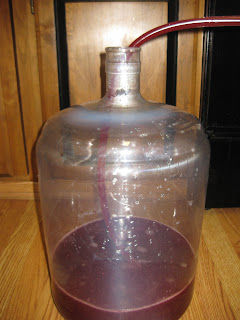
After a week of our house smelling like yeast, we acquired a 5-gallon carboy and auto-siphon to transfer the wine for secondary fermentation.  Taking the cover off the top of the bucket revealed something that looked like sediment on top of the wine.


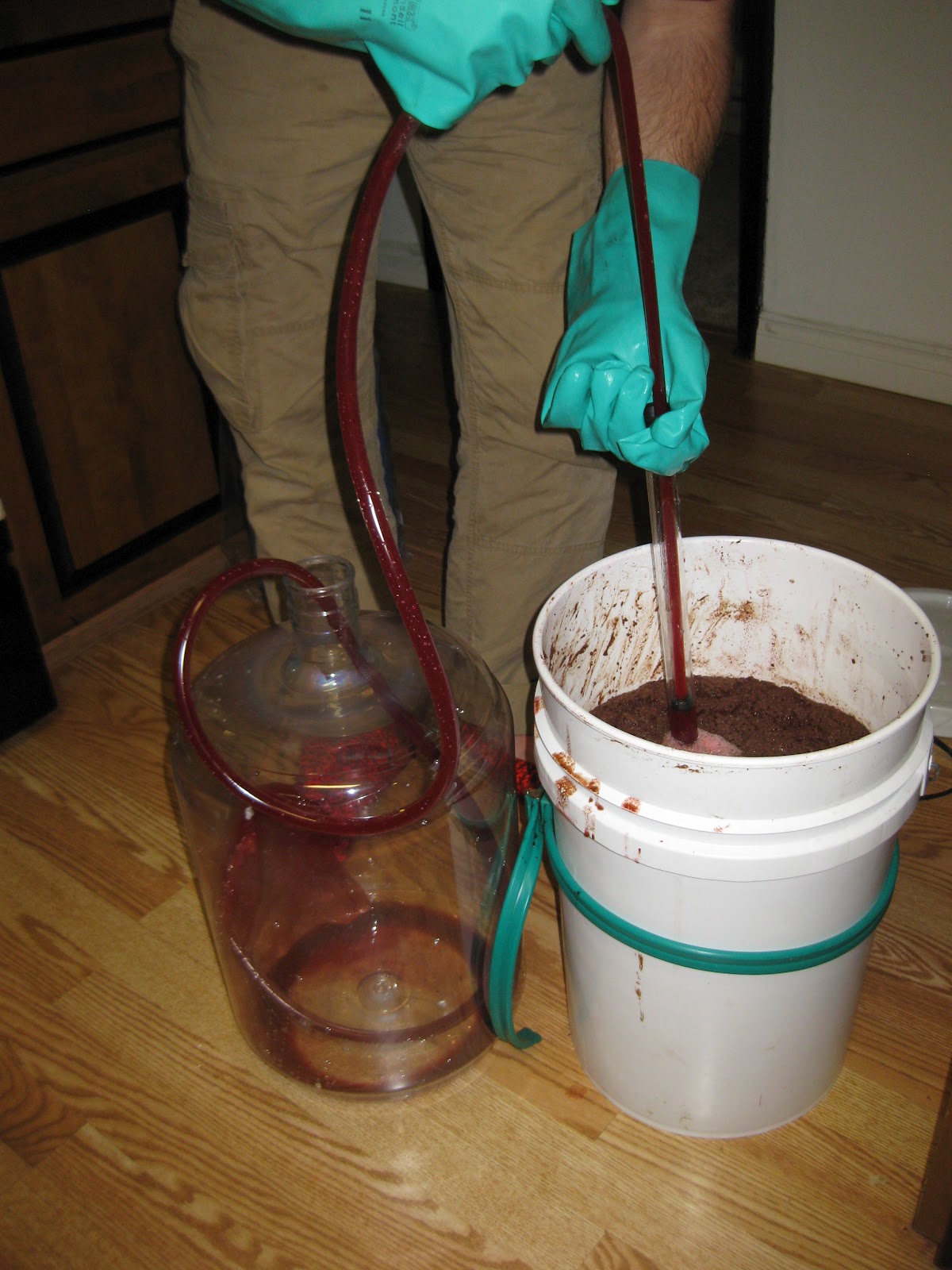
First things first, you have to pull the bag of fruit out and try to squeeze out as much of the liquid as possible.


This was something we were not prepared for and I almost wished we were doing it in the garage.  As my husband squeezed and rung it out, we got some sprays of juice on the cupboards, floor, and ourselves!  (Yes, those gloves look serious and they are serious gloves, but he works in the medical field, so it's what we had to keep both his hands clean and the wine from being contaminated by his hands.) Once that was done, we decided to let the sediment settle again before siphoning.

Just after this, we put the bucket on a chair.
Such a pretty color!
The auto-siphon is a beautiful thing and not much more expensive than a regular siphon that you have to suck on to get started.  Not only is it easier because it's just a pump, but it keeps things as sterile as possible.  As we were transferring the wine, we both couldn't stop marveling at what a nice color it had.  They say to take as much of the liquid as possible, even if it means you're taking sediment with it.
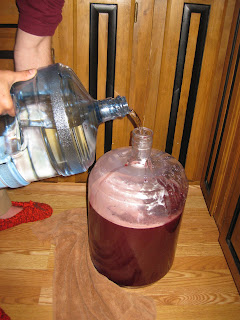
More Fox Spring water, of course.


As you can see, the next step is to fill the rest of the carboy with water because we took out a large bag of fruit, so this is how to get five gallons of wine.  Finally, you have to close it with an airlock, which gets filled with water, so that the wine stays in an anaerobic environment during secondary fermentation, allowing air to escape but not enter.  We then moved it down into the basement and put the warming belt on it.  It will stay there for 4-6 weeks.  

Of course, we couldn't do this without sampling a little of the product so far.  We poured two glasses: one straight from the siphon and one from the drippings of the bag of fermented fruit.
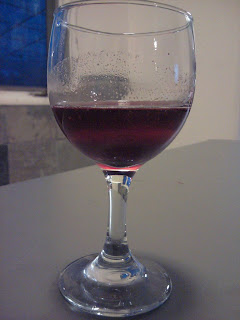
From the siphon.
From the fermentation bag.
The glass on the left tasted more like very sweet rotten fruit than wine.  The glass on the right tasted much, much less like rotten fruit, but it still definitely has a long way to go!  We're looking forward to tasting the next stage in about a month, though it will still have aging to do after that, too.

Monday, August 27, 2012

Winemaking 101: Chapter 2

Last weekend when we went to start our chokecherry wine, we realized that the recipes I'd been looking at were for one gallon.  We wanted to make five gallons.  This was not a huge deal once we found a five gallon recipe, but it did mean that we had to buy a lot more sugar and use ALL of the chokecherries in our freezer plus another two pounds that my husband had to pick before we could get started.  Added to the delay was the fact that over half a gallon of the cherries in our freezer had not yet had the stems removed.

Here's a quick tip for stemming chokecherries:  If you can do it when you clean them, by all means, take the time to do so.  If not, the easiest way is to freeze them then pull small amounts out of the freezer at a time (so they don't thaw) and they are much easier to stem because the skins don't slip off and make a sticky mess all over your hands.  Keep a wet washcloth handy to wipe off any stickiness that will get on your hands anyway, though.

So we finally got to the point of crushing up the fruit to start the primary fermentation process.  Since over half the chokecherries were frozen when we started all of this, my poor husband's hands nearly froze off as he tried to crush up all the cherries.

Chokecherries actually become a very beautiful color when processed.
Once we felt they were sufficiently crushed, they went into a mesh bag inside a five gallon bucket with a mixture of water, sugar, yeast energizer, pectic enzyme, crushed campden tablets, and acid blend.


Finally, you fill the rest of the bucket with water to the 5 gallon mark and cover it with a light-weight cloth so that it can breathe.  Wait 24 hours then add a packet of wine yeast onto the top of it--no stirring.  Cover it with the cloth again and wait a week.


We actually keep our house cool enough (and I don't mean through air conditioning!), though, that we had to get a warming belt because, even in our kitchen, room temperature is about 65 degrees.  Fermentation is best between 70 and 75 degrees.  No way were we going to increase our heating bills just for the wine.  Besides, we plan to make more in the basement where it really doesn't get into the 70s!

Winemaking 101: Chapter 1

We have been talking about making our own wine for almost 3 years.  Both of our grandfathers, at varying points in their lives, made homemade wine.  For various reasons--mainly moving around--we have not been able to start that project.  Upon moving into our house here, we determined that we were finally going to make wine.  Then came the question of what to make.  We both love mead and have talked about making our own almost as long as we've talked about making wine.

Since we still have two mortgages (that and we're just cheap), we decided to attempt this as frugally as possible.  As much as we'd like to make mead, honey is really very expensive.  So to start, we thought we could use a fruit that we know is used to make wine and is free, abundant, and readily accessible in our own yard.  I'm sure you can guess where this is going.  That's right: chokecherry wine!

So we bought the bare minimum of what we needed just to start.  When we were up in Fox, AK, for the Permafrost Tunnel tour, we brought our 5-gallon water jug to fill with water at the natural spring to use that water for our wine.  Silver Gulch Brewing & Bottling Company, located in Fox, uses the spring water to brew all their beer.  As I said in a previous post, we hauled drinking water from this spring for an entire month when we lived halfway between Fairbanks and Fox.  Countless people in the area use this spring water for drinking and cooking, including people from all the way down in North Pole, AK.

Our daughter loves to help get "Fox water."
Fillin' her up.  Yes, we had completely sterilized the bottle.
So last Saturday night we finally got to the business of starting our first five gallons of wine, with plenty of delays and false starts!

Saturday, August 25, 2012

Chokecherry Jam Update

So as what was supposed to be chokecherry jam cooled last night, we realized that it wasn't really solidifying that well.  As such, we now have four pints of chokecherry syrup, one of which is opened and was used on my husband's latest attempt of sourdough pancakes this morning.  It is excellent syrup.  I will let him keep you updated on the pancakes.

Friday, August 24, 2012

Chokecherries, Chokecherries, and More Chokecherries

Chokecherry trees are everywhere in Fairbanks. You can't walk a block without seeing at least one tree.  Many of them are volunteers, but most of them are intentional plantings as ornamental trees, which is actually how they were introduced to this area as they are not native.  We have four chokecherry trees in our yard.  Once we discovered what these trees were, we decided to learn how to tell when they're ripe and what to do with them once they are.  That wasn't too difficult as we've seen chokecherry products throughout our travels in the lower 48.  We'd even bought some chokecherry wine at one point.

The two resources most helpful to us was this article on Wildfoods.info and the University of Alaska-Fairbanks Cooperative Extension.  I have found the UAF Cooperative Extension's publications on native foods to be invaluable resources when learning how to pick, clean, store, and utilize the abundant foods found throughout Alaska.

What's left on some of the upper branches of our big chokecherry tree.

Chokecherries are ready to pick at least 2 weeks after they turn jet black.  The longer you wait to pick them, the sweeter they will be (though I've learned they also start being eaten by birds and falling off the trees the longer you wait).  They will always have a tartness and make you pucker.  I, personally, am not a fan of them straight off the tree.  However, I have liked all chokecherry products I've tried.

Armed with this information and a ready supply in our own yard, I started picking these small black cherries. Between my husband and me we picked all the chokecherries we could reach in our yard, which was about 13 pounds, or two and a half gallons.  Most of them went into gallon bags in our freezer for later use.  I took a small portion of them, though, and extracted the juice.  We tried adding the juice to some homemade pancake syrup my husband had made when we ran out of store bought syrup.  It was nowhere near the same result as true chokecherry syrup.

The rest of the juice has sat in the refrigerator until today because we have been without storage space to make any jam, jelly, or syrup with it.  I finally broke down and bought a flat of jelly jars the other day.  This afternoon, my husband decided to make chokecherry jam.

Chokecherry jam
We currently have four pints cooling in the kitchen, and I have been picking more chokecherries, so I have a couple more gallons to go clean and freeze!